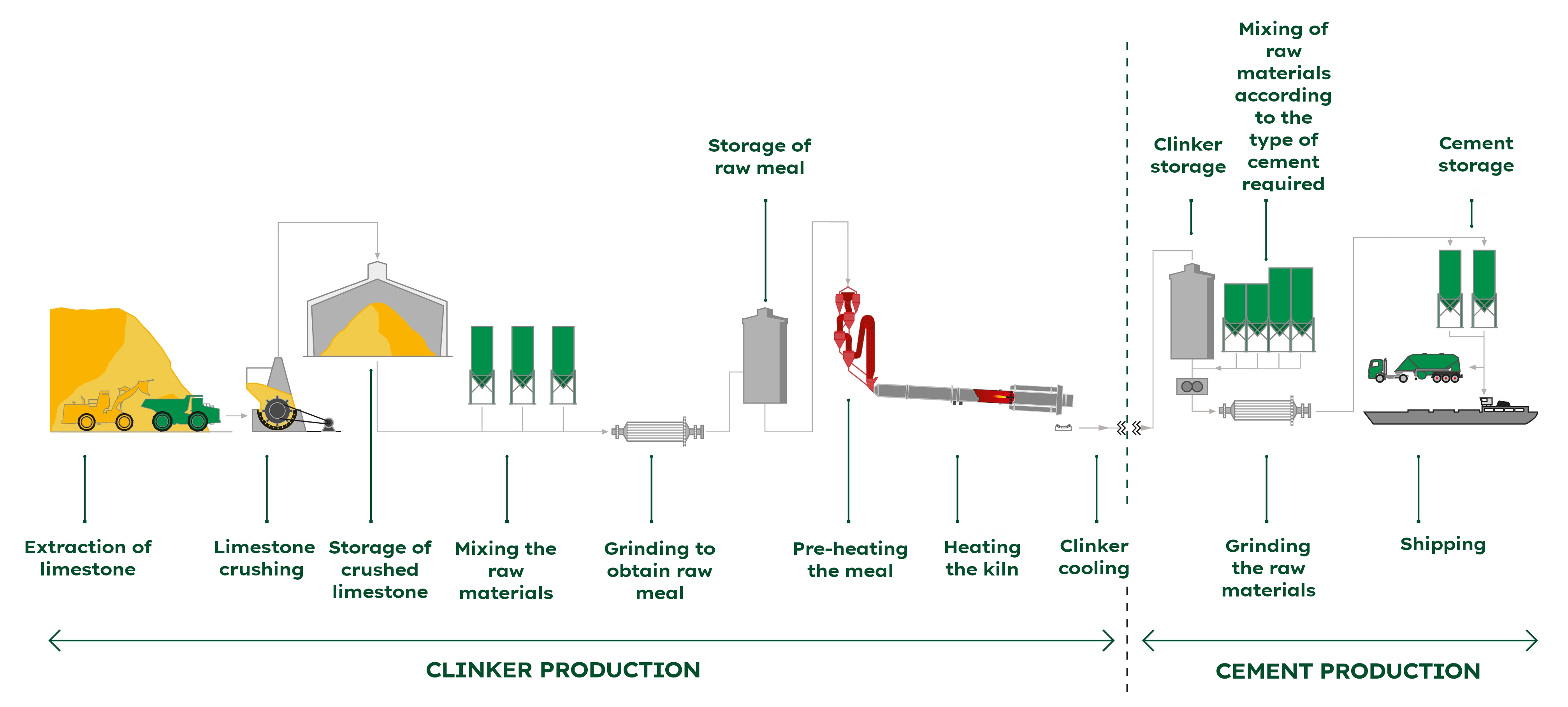
How cement is made

How cement is made

Antoing plant: where it all begins

Concrete is the second most widely used commodity in the world, right after water. The demand for this essential building material is significant and will continue to play a crucial role for modern societies.

Clinker is the primary ingredient of cement. When combined with aggregates and water, cement transforms into concrete.

The Antoing site is a clinker plant. Limestone, the raw material to produce clinker, is extracted from the adjacent quarry, also owned by the Heidelberg Materials Group. Limestone is processed together with some other raw materials such as clay and sand. It is burnt in the kiln at 1.450°C and is chemically transformed into a cementitious product called clinker.

The clinker produced in Antoing will be shipped out to the grinding stations of the group in Flanders (Ghent) and in the Netherlands (Rotterdam and IJmuiden) where it will be ground with other materials into cement.

Cement production process

Insight into unavoidable process emissions
and levers to decarbonize cement

CO₂ emissions

CO2 emissions

The aim of the capture technology is to concentrate the CO₂ in the flue gas and bring this concentration up to more than 90% so it can be compressed, transported and stored.

Learn more

Levers to decarbonize cement

Levers- to decarbonize cement

The company continuously invests in its plants to improve their performance, in order to reduce the overall heat content needed to burn clinker which has positive impact on our CO₂ emissions.

Learn more
Co-founded by the EU

Funded by the European Union under Grant Agreement 101250817. Views and opinions expressed are however those of the author(s) only and do not necessarily reflect those of the European Union or the European Climate, Infrastructure and Environment Executive Agency (CINEA). Neither the European Union nor the granting authority can be held responsible for them.